
Introduction to Translation Technology
It took dozens and even hundreds of years of hard work by mathematicians, engineers, and linguists to make it possible for you to quickly and effortlessly translate the lyrics of your favorite foreign song or social media post!
Modern translation tools are different from the beginning of this thorny journey. Adopting machine translation technology has significantly transformed the translation industry, allowing for increased efficiency and scalability in meeting global communication needs. But there have always been tools for translators because this complex job requires tremendous knowledge and skills that are difficult to keep in your head 24/7. The Language Doctors emphasize the significance of choosing effective translation tools while cautioning against complete reliance on machine translation, as we recognize the irreplaceable role of human touch and linguistic expertise in capturing the essence of a message.
What are the challenges of machine translation that are still relevant today? What do translators use today, and which translation tools can be considered the most effective? And why shouldn’t machine translation technologies be trusted 100%? You will find the answers to these and other questions in this article.
Early Translation Technologies
Mechanical Translation Devices
Machine translation is the translation from one language to another without human intervention. Automatic translation was first discussed almost 100 years ago, in the 1930s. It was then that two scientists, independently of each other, took the first steps into the future of automation and created new translation devices:
- Creation of an automatic dictionary by Georges Artsruni
Georges Artsruni was a famous linguist who contributed greatly to developing machine translation. The “automatic dictionary” device he created was not just a dictionary; it was a whole database with words, phrases, expressions, and their translations, which greatly facilitated the work of translators and helped them find more contextual information for accurate translation.
- Creation of a special machine, a tilting table with a typewriter and camera by Peter Trojansky
Or, as he called it, “a machine for selecting and typing words when translating from one language to another”. The USSR engineer’s invention received a copyright certificate but was soon forgotten for a long time.
The scientists’ ideas were cool but couldn’t be called full-blown machine translation.
But in 1949, Warren Weaver, director of the Rockefeller Foundation’s Natural Sciences Department, published a memorandum on implementing a decoding-based machine translation technology. The paper was a high-profile one, and he also introduced the concept of interlingva to the public for the first time: a source sentence is simplified and converted into English, and then the English sentence is converted into the target language.
The introduction of the concept of interlingua has seriously reduced the number of language pairs to work with. Surprisingly, Interlingva is still used in modern automatic translation systems!
Early Computer-Assisted Translation (CAT) Tools
The digital revolution, which includes automation through sophisticated software, has impacted the field of translation. Nowadays, professional translators have many computer programs that facilitate their work. Together, these programs are called computer-assisted translation (CAT) tools.
CAT programs are special applications that help automate the translation process. The services work on the principle of text editors but with differences. These programs offer access to dictionaries and glossaries, remember the translator’s choice, and automatically substitute the translation of previously translated words in the next similar files. CAT tools have many advantages:
✔️ Convenience
CAT programs greatly simplify a translator’s work. They provide a user-friendly interface for grammar and spelling checks, allowing translators to focus on translation rather than technical aspects.
✔️ Reducing the risk of errors
Translations are stored in a database known as the “translation memory”. If you encounter similar phrases or words in the texts, the CAT tool will automatically suggest a ready translation from the “translation memory”.
✔️ Customizability and adaptability
This is an important advantage of CAT software, including creating specialized glossaries to preserve translation style and terminology. Also, the ability to customize the interface to your liking: arrange toolbars, color scheme, and other parameters for ease of use.
CAT programs help reduce the time translators spend working on similar texts and the percentage of grammatical, punctuation, and spelling errors.
In the 1970s, computer translation programs began to be actively developed.
At that time, the first such program was developed in Japan, called “METAL“. It was a very advanced program at the time, using algebraic methods to translate texts automatically. Unfortunately, it could only be translated from Japanese to English.
In the 1980s, another famous and cool program, “Logos,” was created in the USA.
In addition to translation, this program also offered the possibility of localization: adapting the user interface to other languages and cultural peculiarities.
After the 1990s, CAT programs, well known to us, were created, which supplanted all the previous ones with their capabilities:
- SDL Trados (1992)
- OmegaT (2002)
- MemoQ (2004)
- Wordfast (2006)
- STAR Transit NXT (2008)
- SmartCAT (2012-2015)
The Rise of Machine Translation (MT)
Key Milestones in Machine Translation Development
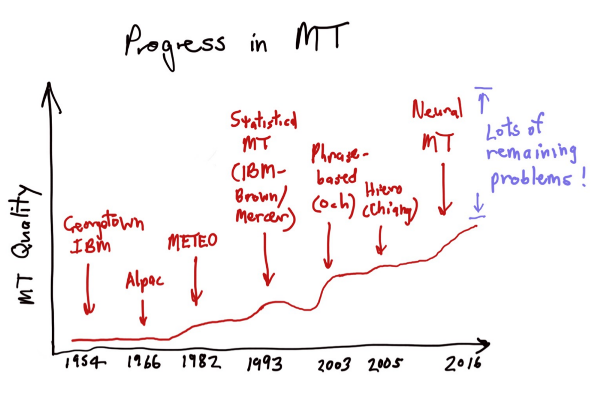
The birth date of machine translation is January 7, 1954. In history, this event is called the Georgetown Experiment.
The first time machine translation was demonstrated in New York; the demonstration was prepared by Leon Doster (professor of linguistics at Georgetown University) and Cuthbert Hird (head of the creative department). In the experiment, they selected a 60-sentence text on organic chemistry and translated it from Russian into English. The computer base included 6 grammatical rules and a glossary of 250 words and phrases.
The quality of the machine translation was not very high, but by using this technology, the translators’ productivity increased fivefold! Unfortunately, the technology was too expensive for mass use, slowing its development for the next two decades.
Since the Georgetown experiment, technology has evolved and led to the creation of other different methods and approaches to translation.
There were created:
- SYSTRAN (1968) was one of the first commercially available machine translation systems, providing English to French translations.
- CANDIDE (1970) is a translator developed in Canada based on linguistic analysis techniques used for English-French translation.
- TAUM METEO (1988) is a machine translator translating meteorological texts from French to English.
In recent years, neural networks have become the basis for modern machine translation systems. As they are more context-aware, they provide better translation quality.
The most popular machine translator, Google Translate, was launched by Google in 2006. Initially, it was based on statistical machine translation (SMT), and since 2016, it has switched to using neural networks. Google constantly receives feedback from users, thus improving the translator.
In August 2017, a convolutional neural network translator, DeepL, was created. Today, it is considered the most accurate translator globally, supporting 31 languages and more than 800 language pairs.
Challenges and Criticisms
The invention of machine translation is one of the fundamental achievements that has opened new opportunities for humanity. Despite its advantages, there are several important challenges and criticisms to consider.
| Characteristics | Before the 2000s | After the 2000s |
| Supported
languages |
Limited number of
(mostly English, French, and Spanish only) |
Huge number of
(Google Translate supports more than 100 languages, including even rare languages: Malay, Swahili, Hausa and others) |
| Accuracy | Low
(Misunderstanding of context) |
Medium
(Improved context recognition) |
| Speed | Slow
(due to limited resources, complex algorithms, and translation technologies) |
High
(A few seconds and the text is ready) |
| Accessibility | Bad
(Required software installation; it was costly and unavailable at the time) |
Available to everyone
(go to site-paste text or document-get translation) |
Today’s machine translators provide much higher quality translations than the first ones. The advancements in translation technologies have revolutionized the accuracy and speed of technology translation.
However, even the most accurate machine translation is far from perfect. The Language Doctors are dedicated to delivering high-quality translation services that bridge language barriers and facilitate global understanding without any challenges! Contact us today.
Cloud-Based Translation Services
Rise of Cloud Technology in Translation
What is Cloud-Based translation? This is a translation that is done using cloud-based services.
When using cloud technology for translation, the text that needs to be translated is uploaded to the cloud provider’s servers, which process it using specialized algorithms and machine translation models. These models are trained on large volumes of text in different languages and can automatically translate text from one language to another.
The demand for using cloud technology translation is growing because it’s fast, profitable, and affordable.
Here are some pretty well-known companies that provide cloud-based translation services:
- SDL Language Cloud
SDL Language Cloud combines all the benefits of basic quality machine translation with settings for connection to SDL Trados Studio 2014, including specialized topics and individual user customization to produce translation results tailored to project terminology and brand names.
- Google Cloud Translation
Google Cloud Translation provides a more accurate machine translation service using artificial intelligence technology and is designed for developers and enterprises that need more accurate, customizable automatic translation in their business applications or services.
- Microsoft Azure Translator
Microsoft Azure Translator is a cloud-based machine translation service that can translate text and documents with a simple REST API call. The service uses state-of-the-art neural machine translation technology.
We live in an age of computerization that increases the pace of workflow while demanding the highest possible quality. Opportunities previously unknown to us are emerging.
Cloud technologies are a hybrid of human knowledge and machine translation. They allow the translator to keep up with the times and remain at a high level of professionalism.
Benefits and Challenges of Cloud-Based Translation
Benefits
✔️ Access to services from anywhere in the world, so there is no need to install local services.
✔️ There is no need to spend money on your equipment; you can use the ready-made cloud infrastructure and pay only for the resources used.
✔️ Continuous updating of the common knowledge base.
✔️ Opportunities for collective work on the project.
Challenges
If a cloud-based system is used by a group of translators with different qualifications, many errors can occur when using the data, resulting in poor-quality work.
For example, a specialist has received a task to translate a text on a certain topic. To automate the work, they decide to use a cloud service. Earlier, their colleague translated a similar text but with a different focus. The system “sees” the similarity of the written text and replaces some concepts with others. The resulting text is of poor quality, which takes much time to correct.
Therefore, if there is a need to use such services, it is better to break the text into fragments beforehand. This will make it easier to identify possible errors and correct them promptly.
Translation Technology and Localization
Website localization is vital for any business looking to enter international markets. More and more companies are looking to enter these lucrative markets, so website localization has become a very popular and lucrative phenomenon.
Here are some commonly employed localization technologies for websites:
- Automatic localization technologies
With the WordPress platform, it’s easy to add translated versions of content to a website. With the Drupal platform, you can easily create and manage multilingual websites.
- Machine translation + editing
It can be useful for translating large amounts of text but with obligatory further editing because it will not ensure high quality and consistency of terminology.
- CAT-Tools
Using glossaries and translation memories in a translation database makes working on website localization much easier and faster.
Emerging Trends in Translation Technology
Nowadays, artificial intelligence is transforming almost every industry.
AI is finding diverse applications in translation and localization – a trend that will be around for a long time. The potential of AI is enormous. We can expect its use to become increasingly sophisticated.
A great example is natural language processing (NLP). NLP occupies an intermediate position between linguistics and computer science, where AI is applied in the interaction of the computer with natural language. There is likely to be a growing focus on specialized applications of NLP, and the language industry plays a key role here.
Innovations Shaping the Future
The future of the translation industry is a fusion of advanced technology and human professionalism.
Quantum Computing in Translation
If this technology is implemented in the future, it will greatly help translators.
Quantum computing can process huge amounts of data and do all sorts of calculations in parallel.
Advanced Language Understanding Systems
Even the best neural network-based machine translation methods already in place can still not capture the cultural nuances of languages. In the future, advanced language understanding systems will become integral to the translation industry and open new opportunities for creating high-quality translations.
Human-AI Collaboration in Translation
As we said earlier, AI cannot replace human translation but can simplify the translator’s job. For example, AI translates – humans edit. Today, the translation industry is one of the key industries for AI technology adoption.
Almost half of companies (46%) want to increase their spending (at least 25%) on AI adoption.
Impact on Translation Industry Professionals

Entering the international market, companies translate their materials into different languages to meet the needs of audiences worldwide. Accordingly, there is a growing need for quality translations. Machine translation has become very accessible in recent years, but today, it cannot fully replace the work of a translator.
We at The Language Doctors prioritize human translators for accurate and high-quality translations, acknowledging the limitations of machine translation. Because of that, our work is highly appreciated by our clients.
But why is human translation the best? Will the development of machine translation affect the work of translators, and what consequences can incorrect machine translation lead to?
Challenges and Ethical Considerations
Human translators strive to provide accurate translations because they understand the importance and impact of these translations. They follow ethical standards and apply quality control methods: revision, review, etc.
Machines translate words, and humans translate meaning.
Just imagine the serious consequences that can result from an inaccurate medical translation! An incorrectly translated diagnosis or prescription can lead to erroneous treatment, incorrect medication, or severe side effects! When it turns out that the translation was incorrect, doctors will have to spend a long time looking for errors and correcting them, and the patient will lose a lot of time that should have been spent on immediate treatment…
In case of incorrect juridical translation, the consequences will be no less serious.
After all, to translate legal documents, the translator needs to be well-versed in legal terms and consider the legal peculiarities of different countries. Machine translators do not consider all this because they simply recognize and translate words. And then, who needs legal disputes because of a misunderstanding of the rights and responsibilities of the parties? Because the parties, based on incorrect versions of translated documents, will present opposite arguments and claims. The result is a long and complicated legal process.
According to the expertise of The Language Doctors, here are three key aspects that machine translation still struggles to handle,
- Terminology
Each industry has its vocabulary, which a person who is not a specialist and has no industry knowledge cannot always fully understand. The main disadvantage of machine translation is the verbatim reproduction of the text. Such translation leads to misunderstandings with the target audience. Translators determine the correct word usage based on context and industry knowledge. The result is a high-quality translation that correctly conveys the meaning of the original.
- Syntax and grammar
The grammar of a language is not a constant; it evolves. This means some constructions or rules may have been unacceptable a few years ago, but now they have become part of speech. Humans naturally internalize such grammatical and syntactic changes, and professional translators keep a pulse on the changes and nuances in their working languages. However, machine translation technology can make mistakes and doesn’t always keep up with the latest changes.
- Expressions requiring cultural knowledge
Translation is more than reproducing the words of one language in another. Translators need a high level of cultural knowledge (of both the source and target language) to convey the message to the target audience without distortion.
Every language has expressions and idioms that make sense in the context of a particular culture but lose their meaning in another language if translated verbatim. Professional translators know how to translate this information because they know the cultural traditions and values. This is why a human translation sounds natural. Machine translation tools, on the other hand, are likely to miss cultural implications, and the original meanings will be lost.
The main disadvantage of machine translation is obvious: unlike a human, a computer does not understand the text it works with.
Systems often get the context wrong, distorting the original meaning of a message to the point of losing it altogether. Machines can never translate humor or wordplay because they do not experience feelings or emotions.
In the end, despite the rapid development of machine translation technology, in the future, human translation will remain the most accurate and of the highest quality.
Conclusion
Integrating machine translation technology into the translation industry has opened up new opportunities for collaboration between human translators and intelligent algorithms, improving the quality and speed of translated content.
It is obvious that at the current stage of its development history, machine translation is not a replacement for a professional translator but only an auxiliary tool. Any automatic translation must be carefully checked, edited, and improved; only then will it be accurate.
We strongly advise against entrusting computers with 100% translation of important documents or tasks. Machine translation can be an excellent basis for further work with the text, but no more than that – and it is more reliable if a professional translator does this work.
The Language Doctors‘ translators have all the necessary knowledge and experience to provide you with accurate and high-quality translations, regardless of their complexity: 20+ years of experience, 200 languages! Request a free quote today: https://app.thelanguagedoctors.org/